
Explore a world of possibilities.

Fort Myers

Fort Myers

Chosen as a winter refuge by Thomas Edison at the turn of the last century, Fort Myers sits away from busier and more opulent Florida centers, maintaining the carefree, low-key atmosphere of a sea town. Assuming beach life is Fort Myers' only attraction would be a mistake: the town center boasts a vibrant street life, with a plethora of indie art galleries and interesting spots for history and science lovers. The area's natural beauty continues inland, where protected animal species take shelter among mangroves and narrow bayou bends.
Read more
Säfsen Resort

Säfsen Resort

In the scenic southwestern Dalarna, Säfsen Resort emerges as a year-round haven of experiences: from a fully-equipped ski facility in winter to exhilarating downhill biking and wilderness adventures in summer, spring and autumn. Säfsen offers a plethora of activities and adventures for the whole family. Additionally, the Säfsen Mountain Bike Park attracts both elite downhill and mountain bikers. The resort is conveniently located just 130 km from Örebro, 270 km from Stockholm, and 340 km from Gothenburg.
Read more
Autumn and winter colours
Le Cap d'Agde Méditerranée, France

Autumn and winter colours

Discover the destination with all the gorgeous colours of autumn, it is also a place worth discovering.
Read more
Krapina-Zagorje

Krapina-Zagorje

If you are looking for a place suitable for a vacation, free from industry and the usual urban disrputions, choose Zagorje with an easy heart. It is an oasis of preserved nature, greenery, clean air and mild, healing waters. A cultural heritage of feudalism in this area marks the architecture of many castles and manor houses set amid idyllic nature. Krapina Zagorje County is well-known for its castles, Krapina Neanderthal and thermal springs translated into modern baths with excellent hotels and a vast gastronomic offer.
Read more
Patras

Patras

Patras is a city of compelling layers. Its history spans four millennia, from ancient Mycenaean roots to a 19th-century golden age, all visible in sites like the hilltop Medieval Castle and the reconstructed Roman Odeon. Today, as a major university town and economic hub, it thrums with youthful energy, evident in its dynamic cultural scene and the legendary Carnival week. It’s a gateway to the Peloponnese peninsula, just a short ferry ride away from Italy and only three hours away from Athens. Choose your adventure!
Read more
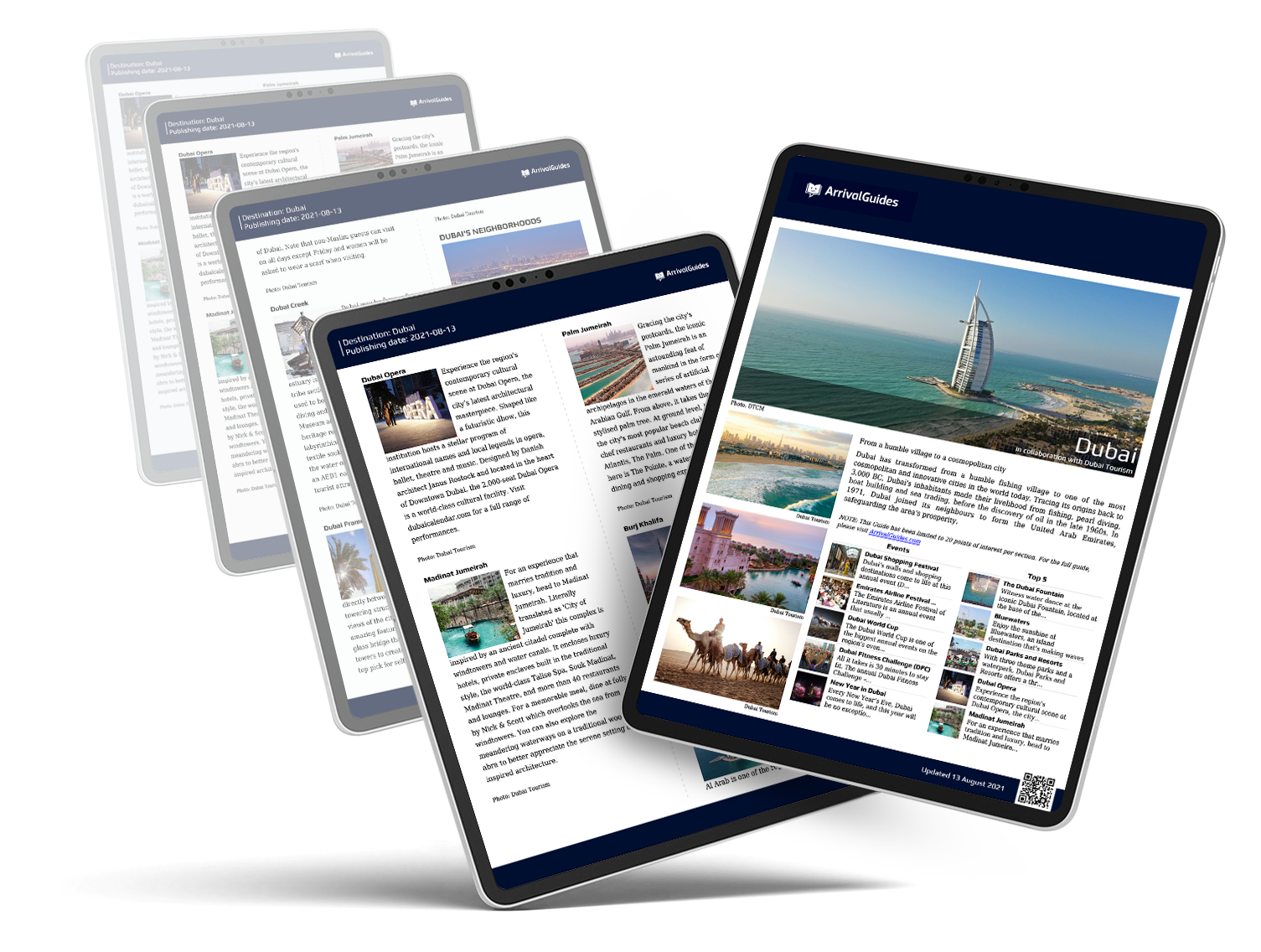
Five Days in Dubai
Dubai, United Arab Emirates

Five Days in Dubai

The sun always shines in Dubai, ensuring endless fun on every holiday. Spend your days lounging at the beach, dining at celebrated restaurants, shopping at al fresco districts and immersing yourself in the city’s cultural best. Our itinerary presents thrills for all ages and settings that inspire.
Read more
Three Days in Dubai
Dubai, United Arab Emirates

Three Days in Dubai

Whether you’re new to Dubai or a seasoned expert, our city always has surprises in store. Explore sky-high landmarks, charming waterside spots and cultural gems aplenty. Or go off the beaten track to hike in Hatta’s mountains, camp under the stars and create memories to last a lifetime.
Read more
Jerez

Jerez

Surrounded by lush vineyards, Jerez de la Frontera is a captivating city known as the birthplace of sherry wine. Immerse yourself in its rich cultural heritage as the cradle of flamenco, home to the mesmerising "dancing" Andalusian horses, and the thrilling capital of motorcycle racing. Wander through the charming historic centre, with its narrow streets, beautiful squares, and iconic Alcazar. Discover the city's allure in unique museums, the atmospheric gipsy quarter, and remarkable architectural marvels that tell stories of its illustrious past.
Read more
Sphinx and Bassin
Maastricht, Netherlands

Sphinx and Bassin

‘This is where the cultural, creative, and enterprising urban district Sphinx will arise.’ So reads the ambition behind the plans for the development of the Sphinx area. Plans focus on the place where Maastricht’s industrial revolution began. It was here that Petrus Regout built his ‘Sphinx Factory,’ the start of what grew into an enormous industry, producing bathroom fixtures, tiles, and the products that made Maastricht great. The factory operated until 2006, and since then efforts have been under way to redevelop this area as a district that fits in with the city, but as something Maastricht does not already have. That’s why this district is being designed to attract creative types, young residents, national and international students, and expatriates. It will be internationally oriented, with room for flexible space and temporary functions. Where this area is going is becoming clearer and clearer, in things like the arrival of the pop music stage in a former sawmill, and the newly opened Brandweer(kantine), with workspaces and meeting places for creative entrepreneurs. But not everything in this part of the city is new and different. The historic and picturesque river harbour ‘t Bassin, adjacent to the Sphinx area, makes a perfect buffer for the transition from the more familiar and better known Maastricht to this new part of town.
Read more
Céramique
Maastricht, Netherlands

Céramique

In the Céramique district, you still feel the industrial past, even though you’re standing in the newest and most modern part of the city. It’s the kind of place where you look up and keep looking, to take in the impressive architecture, even as the ground around you buzzes with culture and activity. Céramique arose in the early 1990s on the site of ‘Société Céramique,’ a ceramics factory that operated from 1850 to 1985, best known for its tableware. When the factory was offered for sale to the municipality in the late 1980s, the idea to redevelop the area as a quality residential and commercial district quickly emerged, and Government Architect Jo Coenen was engaged to develop a master plan. One of his fundamental premises was to bring something of a Mediterranean feel to this part of the city. To achieve this, he brought in luminary architects from southern Europe for the design of the various residential and business complexes. The result is a total package of architectural high point after high point, like Mario Botta’s ‘La Fortezza,’ Alvaro Siza’s ‘Tower of Siza,’ and perhaps the crowning glory, Aldo Rossi’s Bonnefanten Museum. But despite all the forward-looking architecture, the connection to the past remains, in the street names, remnants of older buildings and tableware that turn up unexpectedly, and the exhibitions in the Bonnefanten Museum and Centre Céramique. Each and every one is a golden thread of history interwoven into the fabric of today.
Read more