
-
Provided by: Diana Polekhina/Unsplash
Our travel guides are free to read and explore online. If you want to get your own copy, the full travel guide for this destination is available to you offline* to bring along anywhere or print for your trip.
*this will be downloaded as a PDF.Price
€4,95
Pharmacy
The guide was updated:In Dubai, popular pharmacy chains include Aster Pharmacy, Life Pharmacy, Boots, and BinSina, all reliable for prescriptions, over-the-counter medicines, and travel essentials like sunscreen, insect repellent, and basic first-aid items. Many branches are open late or even 24/7, especially near malls, hospitals, and metro stations. Staff usually speak English and can advise on common health issues, but note that some prescription drugs may require a doctor’s note.
Useful Information
Digital Travel Guide Download
Our travel guides are free to read and explore online. If you want to get your own copy, the full travel guide for this destination is available to you offline* to bring along anywhere or print for your trip.
*this will be downloaded as a PDF.Price
€4,95
Al Maktoum International Airport (DWC), also known as Dubai World Central, is located 37 kilometres southwest of Dubai city in the Jebel Ali district. As the centrepiece of the large-scale Dubai South development, this airport is poised for significant expansion. It will become the world's largest aviation hub, with plans to handle up to 260 million passengers annually and replace Dubai International Airport (DXB) entirely by 2035.
The most practical way to reach the airport is by road via Sheikh Mohammed Bin Zayed Road (E311). For public transport, take the Dubai Metro Red Line to Ibn Battuta station and transfer to the F55 bus service, which completes the journey to the terminals.
Read more
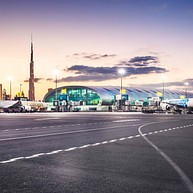
Dubai International Airport (DXB)
Dubai International (DXB) is located 4 kilometres southeast of Dubai. One of the world's busiest travel hubs, Dubai's primary airport boasts three sprawling terminals and two huge runways that operate around the clock, serving both passenger and cargo planes. Transportation from the airport is possible by taxi, bus, or metro.
Read more
Climate
Dubai is warm most of the year. The cooler months, from October to April, see temperatures from around 20°C up to the mid-30s, making it ideal for outdoor activities. From May to September, it heats up, often reaching the high 30s to mid-40s, so indoor attractions, beaches with shaded areas, or early-morning and evening outings work best during this period. Luckily, Dubai offers plenty of attractions for all seasons.
Read more
Dress code and customs
Dubai is cosmopolitan and generally tolerant of different styles, but it truly helps to follow a few guidelines when visiting the city.
In older parts of Dubai and at religious sites, dressing more conservatively is appreciated. In mosques, women should cover their shoulders, arms, and legs, and wear a headscarf. Swimwear is fine at beaches, pools, and water parks, but not appropriate in business districts, malls, or on the streets.
Public displays of affection are limited. Holding hands is usually fine, but kissing and hugging in public are frowned upon.
Alcohol is available in licensed hotels, bars, and shops for those over 21, but public drunkenness, disorderly behaviour, or drunk driving is illegal. The use or possession of drugs is strictly prohibited.
Read more
Ramadan
Ramadan is the holy month of fasting observed by Muslims, and in Dubai, it’s a time of reflection, family, and tradition. During the day, you’ll notice that the city is a little quieter. But when the sun sets, Dubai transforms: vibrant Iftar meals fill the streets, food markets buzz, and the night comes alive once again.
While in Dubai during Ramadan, it’s polite to avoid eating, drinking, or smoking in public during daylight hours. Many restaurants and cafés are closed or operate with screened-off areas, so planning ahead is a good idea.
Read more
Public Transport
Dubai’s public transport system is modern, extensive, and convenient for tourists. Operated by the Roads and Transport Authority (RTA), it includes the Dubai Metro (Red and Green Lines), buses, trams, water taxis, and taxis. The metro is especially useful for reaching major attractions like Dubai Mall, Burj Khalifa, and Dubai Marina, while buses and trams cover areas not served by rail.
In order to use public transport, travellers should get a Nol card, a rechargeable smart card accepted on all RTA transport modes, including metro, buses, trams, water taxis, and even parking. Fares are zone-based, and using a Nol card gives discounted rates compared to single-ride tickets. It can be topped up at metro stations, retail outlets, or online, making it easy to keep moving around the city.
Read more
Taxi
Taxis in Dubai are both plentiful and metered, making them a convenient option for getting around the city. The standard taxis are cream-coloured vehicles with a coloured roof. These taxis can be hailed directly from the street, booked via the official Dubai Taxi Corporation app, or through popular ride-hailing platforms like Uber, Careem, and Hala.
Read more
Pharmacy
In Dubai, popular pharmacy chains include Aster Pharmacy, Life Pharmacy, Boots, and BinSina, all reliable for prescriptions, over-the-counter medicines, and travel essentials like sunscreen, insect repellent, and basic first-aid items. Many branches are open late or even 24/7, especially near malls, hospitals, and metro stations. Staff usually speak English and can advise on common health issues, but note that some prescription drugs may require a doctor’s note.
Read more
Post
Dubai’s main postal provider is Emirates Post, which operates many branches across the city. The Dubai Central Post Office on Zabeel Road in Al Karama is the most convenient for travellers. It is open Monday to Friday from 8am to 8pm, and it handles local and international mail, courier services, money transfers, and other government-related services.
Read more
Telephone
Country code: +971
Dubai area code: 4
Read more
Electricity
Dubai operates on a standard voltage of 220–240 V with a frequency of 50 Hz. The most common plug types are Type G (three rectangular pins), Type D (three large round pins in a triangular pattern), and Type C (two round pins). Type G is the official standard, widely used in Dubai and the broader UAE.
Read more