
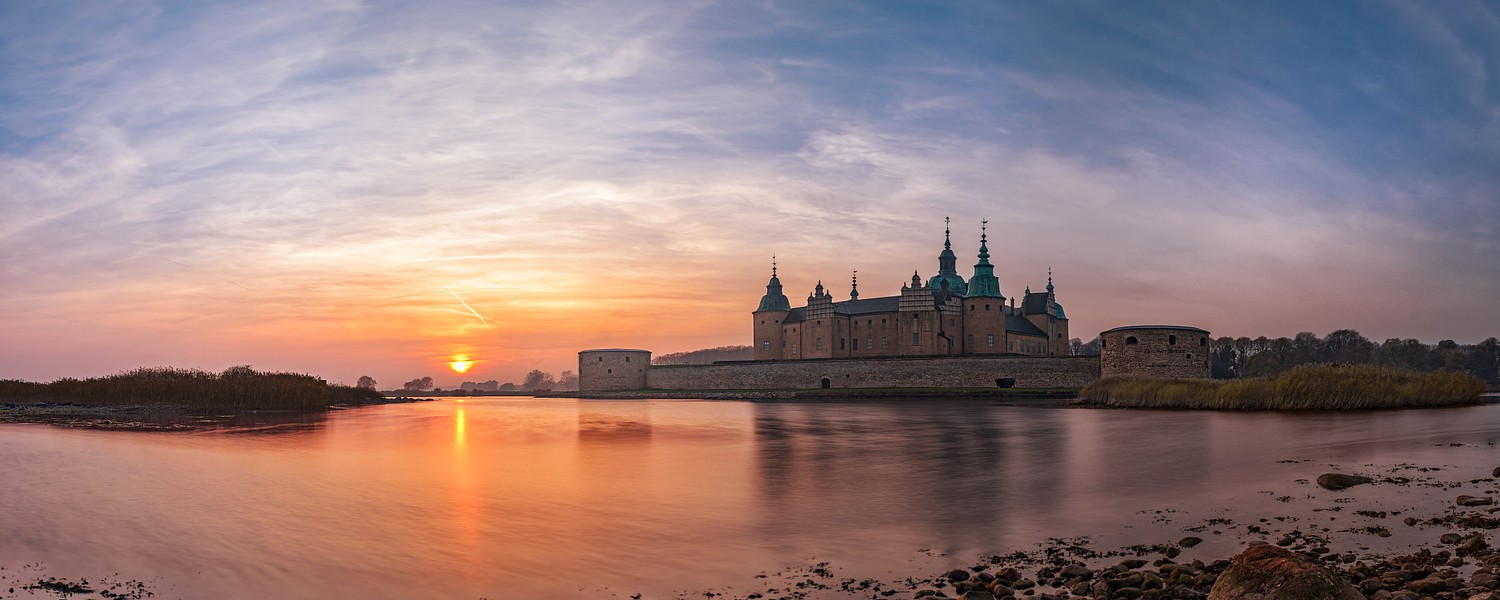
In Kalmar you stroll on venerable paths. With its architecture and city plan, its walls, cobblestone streets and stone buildings from the 17th century, the city has done an exceptional job of preserving the memory of Sweden’s period as a great power. Experience Old Town, which lies right next to Kalmar Castle, Kalmar Länsmuseum with its Crown exhibition and Kalmar Konstmuseum with its much-discussed exhibitions in newly constructed premises designed by Tham & Vidergård Architects.
Kalmar County Museum
The existing county museum building was erected in 1932 as a five-storey granary for Kalmar Ångkvarn (Steam-mill). City architect J Fred Olson designed the building in 1930–31 with crenellation and everything. When a fire destroyed the original mill in the oldest part of the northwestern district, the mill machinery was moved here instead after adding a storey to the building, giving it the appearance it has today. The former mill building then became the granary.
Kalmar Art Museum
Kalmar Konstmuseum with the Design Archive in Pukeberg, Nybro, is the museum for art and design in Kalmar County. The collections cast light upon the development of art and design during the 19th and 20th centuries up until the present day. Kalmar Konstmuseum displays temporary art history exhibitions and contemporary art with both regional and national perspectives as well as international art with a special focus on northeastern Europe and the Baltic.
Krusenstiernska Gården
When you pass through the entrance to Krusenstiernska Gården, you take a step back in time. The main building has been preserved intact since the 19th century and is an example of how the lower aristocracy lived. The building is filled with things from different epochs and countries. All are inheritances and articles that the family has collected for several generations. Much of the furniture is Gustavian, but there are also examples of baroque and rococo styles here. Krusenstiernska Gården is also known for its fine East Indian porcelain. In the garden you can enjoy a cup of coffee from the café. Inside the red fence you will find a spacious garden filled with old walnut and fruit trees, berry bushes and flowers, and in front of the brewery there is a herb garden with several herbs and medicinal plants. Seashells border the paths, decorative cast iron furniture is set out, and with a little stroll in the garden you will find that one of the paths leads to a gazebo. The Krusenstiernska Gården is open between May and September every year.
Kalmar Cathedral
Kalmar Cathedral is one of the few unaltered buildings from Sweden’s period as a great power. The interior was laid out according to Evangelical Lutheran tenets with the altar as the focal point. The cathedral’s furnishings and fixtures reflect Sweden’s great power period with graves, epitaphs and a splendid baroque altar. This altar was designed in 1704 by Nikodemus Tessin, the younger, and depicts the Trinity: Father, Son and Holy Spirit. The oldest fixed content in the cathedral is the pulpit, which was created by sculptor Baltzar Hoppenstedt in the mid-17th century. It was transferred from the previous Storkyrkan (Great Church). The chancel’s floor consists of tombstones from the 17th and 18th centuries, and many of them have great artistic value. A door at the side of the chancel leads to the Christopher Chancel, which is named after the city of Kalmar’s patron saint, Saint Christopher. The chapel is used for private devotions and smaller church services. The cathedral has three church bells, all from the 17th century and obtained from the medieval Storkyrkan.
Kalmar Maritime Museum
Farthest out on Kattrumpan, next to the old warm public baths, is Kalmar Maritime Museum at Södra Långgatan 81. There are several signs that point the way to the museum, which receives a couple thousand visitors annually. Kalmar Maritime Museum is a little gem in the centre of Kalmar that is well worth a visit by both young and old. If you are lucky, you might get a guide who has sailed the seven seas and who can relate salt-spattered tales about life at sea. At Kalmar Maritime Museum there are thousands of nautical artefacts, ship models, paintings and exotic objects from near and far horizons. Kalmar Maritime Museum has about 5,000 items in its collections, and it is considered one of the most interesting of the country’s smaller museums. There are several rarities here, and the museum seeks to maintain the authentic atmosphere of a small, traditional maritime museum. It smells of tar and the roar of the sea can be heard in the seashells.
Old Town
Kalmar’s medieval town centre, which today is called Old Town, is located right next to Kalmar Castle. Well-preserved 17th and 18th century buildings still remain here, inviting cultural-historical strolls. A 1647 fire largely devastated this whole section of town. Subsequently Kalmar authorities decided to move the city to Kvarnholmen. After much pressure, the population reluctantly moved, and where the old section of town lay, townsmen began building “lustgårdar” (pleasure gardens) for summer use. With its winding alleys and small old houses, Old Town allows you to experience the real old Kalmar. You can walk here on your own or with a guide.
Stadsparken
City Park, ”Kalmar’s green drawing room”, is located next to the castle and is a frequented oasis that was named Sweden’s most beautiful urban park in 1985. The park was laid out during the 1877-1880 period through a donation by wholesaler Johan Jeansson. There was such a large outpouring of public joy over the park that a bust of the major donor was put in place. This bust was done by artist Arvid Källström, who also created “Springflickan“, the sculpture that embellishes the park’s pond. City Park has the characteristics of a romantic English park, where the design has been patterned after nature. Soft lines with an abundance of trees and bushes give the park alternating open and closed spaces. There are light and shadowy sections, which is typical of the English park style.
Stensö Outdoor Recreation Area
Stensö beach, about 2.5 km south of central Kalmar, is one of Kalmar most popular recreation areas. It has four star camping, cabins, a public beach, a café and restaurant, jogging paths, mini-golf, and a beautiful countryside. Go walking on the hiking paths to enjoy the varied scenery. See the diverse wildlife, take a dip in the Kalmar Sound or visit the spot where Gustav Vasa disembarked in 1520 after his time in exile.
Västerport
The magnificent city gateway is called Västerport or Högvakten. It was completed in 1658 and was the main entrance to Kvarnholmen up until 1870. For a long time military forces were stationed inside the vault. However, today it is home to sales and production of glass by Westholms Glasstudio and sales of chocolate, coffee and tea by Västerport Handelsbod as well as a place for recreation and treatment at Västerport Spa & Relax. See links to these activities under ’More information’ to the right. In 1997 reconstruction was completed of the Ravelin bridge to Malmen, where it comes across by the prison. You will find Västerport at the beginning of Västra Vallgatan (city centre).