
Explore a world of possibilities.

Phnom Penh

Phnom Penh

Situated at the crossroads of three great rivers – the Mekong, Tonle Sap, and Bassac – Phnom Penh is the heart of a country steeped in tradition, overflowing with rice paddies, jungles, and rural communities. Once a sleepy backwater, Phnom Penh, now, buzzes with commercial activity as the country develops after years of isolation. Old French colonial mansions stand alongside newly emerging designs, which make the city’s mixed architecture and communities fascinating to explore.
Read more
Autumn and winter colours
Le Cap d'Agde Méditerranée, France

Autumn and winter colours

Discover the destination with all the gorgeous colours of autumn, it is also a place worth discovering.
Read more
Lake Balaton

Lake Balaton

Hungary has no marine coastline, but it does have the largest freshwater body in Central Europe, Lake Balaton. The lake has been popular since the Magyar tribes first galloped into the Carpathian Basin in 896, and it shows no signs of losing its appeal. A collection of resort towns and an interesting bicycle route ring the 77 km long lake. Hévíz-Balaton Airport is 20 km from Keszthely at the southern end of the lake. From there, you can hire a car or take a bus and explore some of the resorts.
Read more
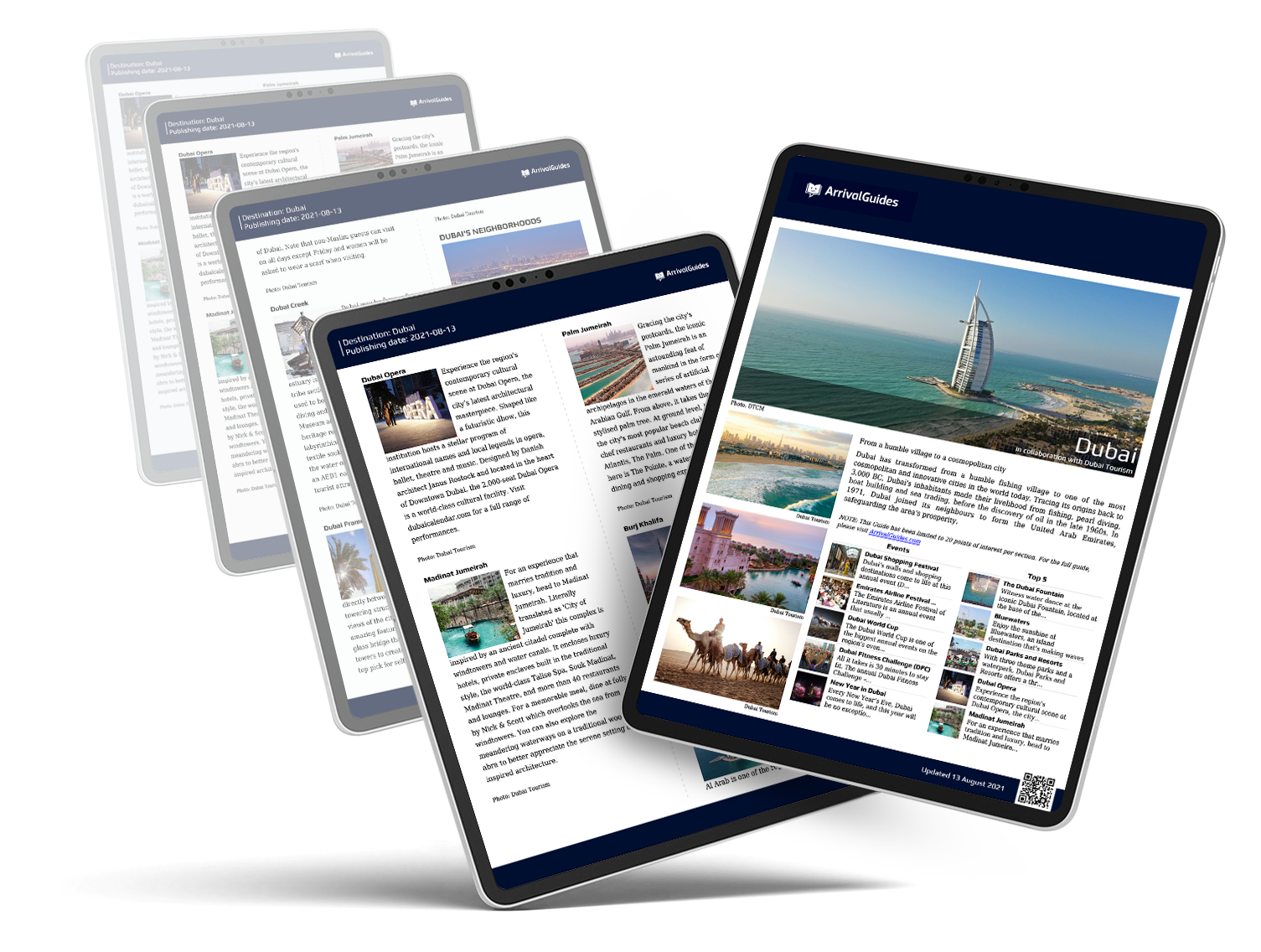
Five Days in Dubai
Dubai, United Arab Emirates

Five Days in Dubai

The sun always shines in Dubai, ensuring endless fun on every holiday. Spend your days lounging at the beach, dining at celebrated restaurants, shopping at al fresco districts and immersing yourself in the city’s cultural best. Our itinerary presents thrills for all ages and settings that inspire.
Read more
Three Days in Dubai
Dubai, United Arab Emirates

Three Days in Dubai

Whether you’re new to Dubai or a seasoned expert, our city always has surprises in store. Explore sky-high landmarks, charming waterside spots and cultural gems aplenty. Or go off the beaten track to hike in Hatta’s mountains, camp under the stars and create memories to last a lifetime.
Read more
Casimirsborg Country House
Västervik, Sweden

Casimirsborg Country House

Casimirsborg, a historic estate dating back to 1380, features parts of its original castle in the cellar vaults. The current building, from 1829, boasts period details like the grand salon, the largest private hall in Tjust and northern Småland, and a unique neo-Gothic chapel. It houses a cultural museum in the old granary, showcasing exhibitions on agricultural history, the Bronze Age, and painted floors. The estate also holds significant Bronze Age remains, indicating its past as a regional power centre. With untouched Bronze Age environments, Casimirsborg offers popular guided tours combining lectures with visits to ancient graves and rock carvings.
Read more
Nice Côte d'Azur

Nice Côte d'Azur

The Greeks and Romans did it, as did rich lords, film stars, artists, and thousands of tourists. They were just going to pass by but instead remained in Nice and along the Riviera. Some for just a few weeks, others for months and years. They were too captivated by the light, enchanted by the scents, and charmed by the taste of olives and wine. Additionally, a Nice Nouveau has evolved – a sassy Mediterranean metropolis with pulsating nightlife, modern hotels, and daring art galleries. All this with a chance to dabble their toes in a turquoise sea.
Read more
St Gertrud's Church
Västervik, Sweden

St Gertrud's Church

When Västervik was founded at its current location in 1433 by Eric of Pomerania, the inhabitants were granted four tax-free years, the first of which was to build a church. Services were held here for nearly 500 years, with the last high mass on the Feast of Christ the King (Domssöndagen) in 1905. The new church, St Peter's, was consecrated on the first Advent of the same year. Since then, St Gertrud's was used for various purposes, including for grain storage during the First World War. Eventually, the idea to restore the church as a place of worship emerged, and St Gertrud's was re-consecrated on 18th June 1933. The church's original tower, destroyed by lightning during a service in 1762, was replaced in the 1780s by the current one, designed by the renowned architect Carl-Fredrik Adelcratz. Among the church's many valuable artefacts is a Wistenius organ from 1743, considered one of Sweden's most precious organs.
Read more